All Categories
Featured
Table of Contents
All GCC countries deal with the difficulty of guaranteeing future employment for nationals while maintaining reliance on foreign workers to fill specific functions, the seriousness of this issue varies across nationwide contexts considering that GCC countries' demographics and concern locations diverge considerably. For nations that rely heavily on foreign labour, there is a risk that shift procedures will worsen bad working conditions and increase workers' vulnerability to exploitative practices.
Economic diversity and associated green shift plans produce adequate chances but likewise enhanced responsibilities for business running in the GCC area. Throughout this process, both federal governments and organizations have a responsibility to regard and advance employee well-being and account for future labour requirements through, for example, ensuring good working conditions and investing in filling future abilities gaps.
Whereas federal governments are required to offer robust regulatory frameworks and enforcement mechanisms in line with international requirements, organizations have a duty to respect globally recognised human rights and labour standards in line with the UN Guiding Concepts on Company and Human Rights. Services can also use their leverage to guarantee that governments and partners reinforce policies and responsibility systems, providing an environment favorable to accountable organization practices.
Expecting this risk and structure capability around how to resolve this issue within the GCC context will be crucial to promoting accountable company in the region.
For decades, hydrocarbon revenues shaped the political economy of the Gulf Cooperation Council (GCC). In 2010, oil and gas accounted for more than 70% of federal government revenues across the majority of GCC states. Today, that figure is gradually decreasing not since oil has ended up being unimportant, however due to the fact that diversity has moved from aspiration to execution, Invest-Gate reports.
Analyzing GCC Equity Market Shifts for 2026
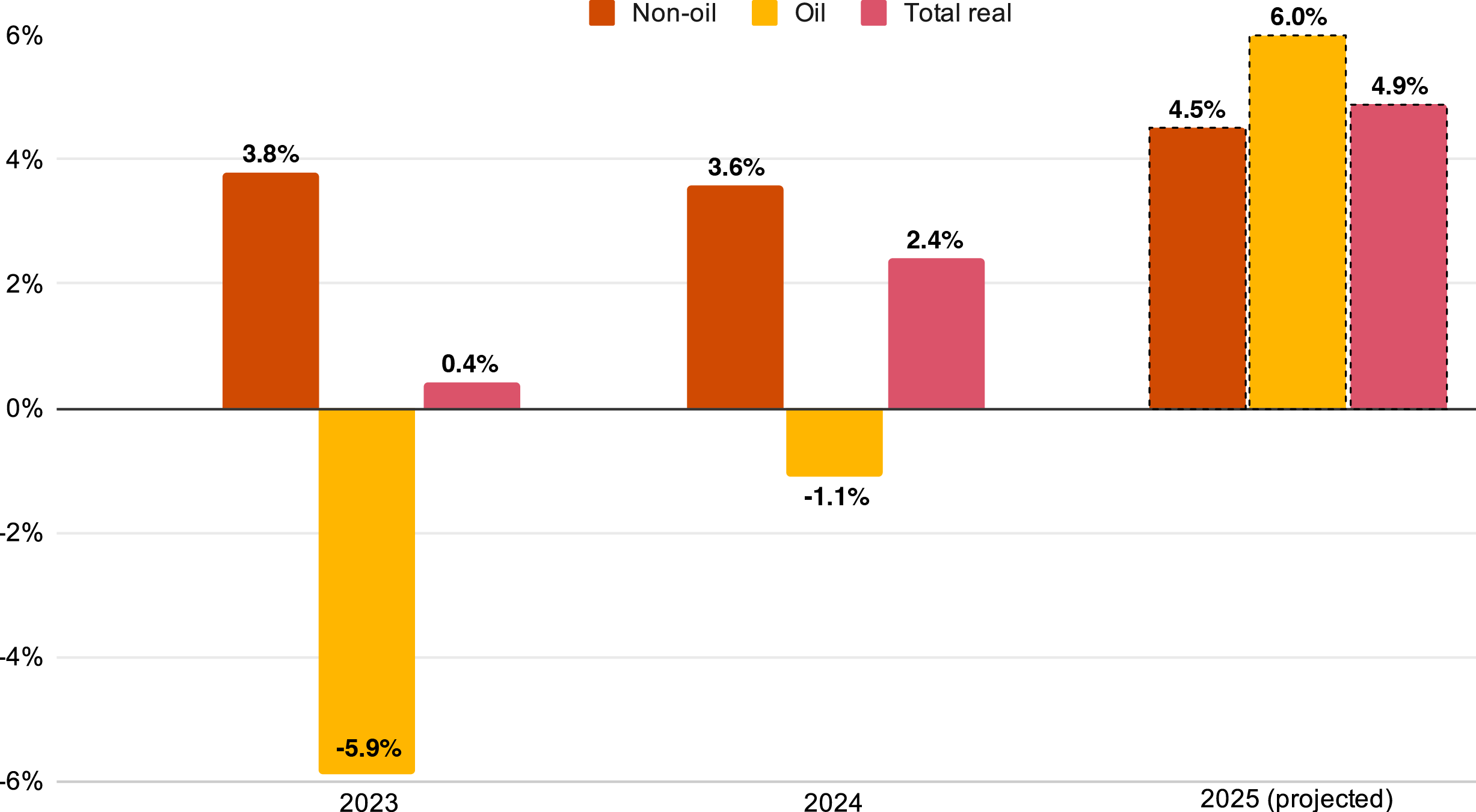
The UAE's non oil sector broadened by more than 6% in 2023. It is a structural improvement redefining financial impact and capital allotment in the region.
Oman and Bahrain have actually pursued fiscal debt consolidation and logistics driven diversification. These techniques operate as financial operating systems coordinating policy, capital implementation, facilities advancement, and foreign financial investment attraction.
The UAE attracted more than $22 billion in FDI inflows in 2023, ranking amongst the top global receivers. QatarEnergy dedicated over $30 billion to LNG expansion while parallel financial investments streamed into innovation and sovereign portfolios abroad. Facilities, tourist, technology, renewable resource, and logistics are now taking in capital when focused in upstream oil jobs.
Roadmap to Gulf Stock Equity Trends for 2026
Diversification is not just economic it is geopolitical. Economic power is increasingly determined by: Control over international logistics passages Sovereign wealth fund impact in international markets Technological ecosystems Capability to bring in worldwide skill The UAE has actually placed itself as a global financial and logistics hub. Saudi Arabia is leveraging scale and domestic need to reshape local supply chains.
As non-oil sectors broaden, fiscal resilience improves. Break even oil costs have actually gradually decreased in some GCC states due to varied revenue streams, including VAT, corporate taxes, and investment earnings.
Saudi Arabia led the area in IPO proceeds in 2023-2024, while the UAE continues to dominate in startup financing and tech environment maturity. This redistribution of economic gravity is gradually recalibrating regional impact.
Benefits of Scaling Industrial Ventures across the GCC
The GCC is not moving "away" from oil it is moving beyond dependence on it. Hydrocarbons will remain central to fiscal strength and sovereign investment capacity. The tactical shift lies in changing oil wealth into diversified financial power. By 2030, non-oil sectors are forecasted to contribute most of incremental GDP growth throughout the area.
The improvement underway is redefining both local hierarchy and global capital integration.
Sweeping changes are concerning countries in the Gulf Cooperation Council (GCC). The United Arab Emirates (UAE) and the Kingdom of Saudi Arabia (KSA), long reliant on hydrocarbon exports, are charting a vibrant new course towards financial diversification. Local production and manufacturing are at the forefront of the shift, alongside burgeoning sectors, including tourism, retail, and technology.

Latest Posts
Analysing the 2026 GCC Economic Outlook
How Economic Shifts Can Shape GCC Markets
Assessing GCC Investment Resilience for 2026